

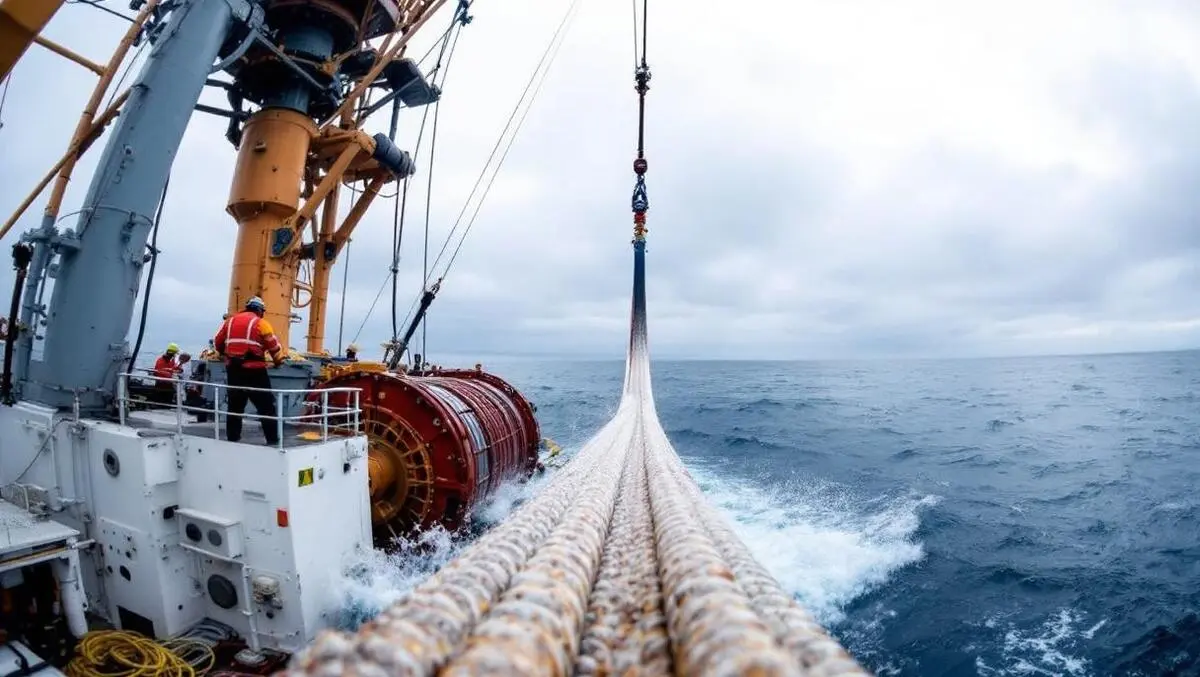
Explainer: The first transatlantic fibre cable is being hauled up
Mon, 16th Mar 2026
A cable laid across the Atlantic Ocean in 1988 helped establish the foundations of modern global connectivity. Decades later, segments of that system are being lifted from the seabed with little public attention.
The cable, known as TAT-8, was the first fibre-optic telecommunications system to span the Atlantic. Its installation marked a turning point in international communications infrastructure. Today, the system is long retired, yet its physical remains still lie across sections of the ocean floor.
Recent recovery operations illustrate a largely unseen stage of digital infrastructure. Networks are built, used, replaced and eventually dismantled. For most internet users, this lifecycle happens out of sight.
Copper eraBefore fibre optics, most transatlantic communication relied on copper coaxial cables. These systems had limited capacity and were designed primarily for voice calls.
The first transatlantic telephone cable entered service in 1956. Known as TAT-1, it carried 36 simultaneous telephone circuits between North America and Europe. Later generations increased capacity, but demand for international communication expanded rapidly during the 1970s and 1980s.
Satellite systems also handled long-distance calls. Yet satellites introduced latency and limited bandwidth compared with cables. Telecommunications operators began searching for a technology capable of handling growing digital traffic between continents.
Fibre breakthroughFibre-optic technology offered a new approach. Instead of electrical signals travelling through copper, communication could be transmitted as pulses of light through glass fibres.
Researchers in the late 1960s and early 1970s made advances that reduced signal loss within optical fibres. These improvements allowed signals to travel much greater distances. By the late 1970s, fibre networks were operating in some domestic telecommunications systems.
Building an ocean-spanning fibre system required additional engineering. Optical signals weaken over distance, so repeaters must amplify them along the route. Engineers developed undersea repeaters capable of functioning reliably on the seabed for decades.
The projectTAT-8 was built by a consortium of telecommunications operators including AT&T, BT and France Télécom. The system entered service in December 1988.
The cable stretched roughly 5,800 kilometres across the Atlantic. It connected landing points in the United States, the United Kingdom and France. One endpoint was near Tuckerton in New Jersey. Another was at Widemouth Bay in Cornwall. A branch extended to Penmarc'h in Brittany.
The project cost about USD $335 million. At the time, it represented one of the most technically complex telecommunications infrastructure projects undertaken.
Initial capacityTAT-8 carried a capacity equivalent to roughly 40,000 simultaneous telephone calls. That represented a major increase compared with earlier copper systems.
The cable used two working fibre pairs and an additional backup pair. Repeaters placed at intervals along the route regenerated the optical signals.
Despite its scale, demand quickly absorbed the new capacity. Within about two years, usage approached the system's limits. Additional fibre-optic cables were planned soon after.
Internet transitionTAT-8 was not originally designed for the consumer internet. The system primarily handled voice traffic and leased data circuits for corporate customers.
Financial institutions, airlines and multinational companies leased dedicated capacity. These circuits supported early digital communications between offices and data centres.
During the 1990s, the rise of the public internet transformed demand for international data links. Fibre-optic cables became the backbone of global network infrastructure. New transatlantic cables rapidly surpassed the capacity of early systems like TAT-8.
Rapid expansionModern subsea fibre systems carry far greater volumes of data. Improvements in optical transmission allow multiple wavelengths of light to travel through a single fibre.
Each wavelength can carry large volumes of digital traffic. As a result, a modern cable can support many terabits per second of capacity.
Private investment also reshaped the industry. Early cable systems were often built by consortia of national telecom operators. In recent years, technology companies and specialised infrastructure investors have financed new cables to support global data networks.
Hidden networkSubsea cables carry most international internet traffic. They connect continents and link national networks.
Hundreds of systems now span the global seabed. Their combined length reaches well over a million kilometres.
Despite their importance, the cables remain largely invisible to the public. They are usually about the thickness of a garden hose in deep water. In coastal areas they are buried beneath the seabed to protect them from fishing gear and anchors.
End of serviceTAT-8 stopped operating in 2002 after a fault disrupted part of the system. Repairing the ageing infrastructure was considered uneconomic.
The cable was abandoned in place on the seabed. This is common practice for retired subsea cables. Removing them can be complex and costly.
Design life for most modern subsea telecommunications systems is around 20 to 25 years. After that period, cables are often replaced by newer systems with greater capacity.
Recovery workIn recent years, operators have begun recovering some out-of-service cables. Salvage companies use specialised grappling equipment to locate and retrieve cable sections from the seabed.
Recovered segments are brought aboard cable ships and transported to shore. Ports in Europe have received large quantities of retired cable during recovery operations.
Once ashore, cables are processed to separate materials. Steel armouring, copper conductors and plastic coatings can all be recycled.
Materials valueEven fibre-optic cables contain valuable metals. Copper conductors are used to power repeaters along the route.
Recycling operations can recover copper and steel for reuse in other industries. This material value helps offset the cost of recovery operations.
Environmental considerations also influence decisions about removing old cables. Some projects seek to clear space along established routes so new systems can follow the same corridor.
Quiet milestoneThe removal of TAT-8 highlights how digital infrastructure evolves. The system once represented the frontier of telecommunications engineering. Today it has been overtaken by cables with vastly greater capacity.
Yet its historical role remains significant. The project demonstrated that fibre optics could support large-scale ocean-spanning networks.
The cable helped shift global telecommunications away from copper and satellites toward optical fibre. That transition made the modern internet possible.
Continuing networkWhile early systems like TAT-8 are being dismantled, the subsea cable network continues to expand. New routes are planned each year to meet growing demand for cloud services, video streaming and international data exchange.
Technology companies now invest directly in some of these projects. Their data centres rely on high-capacity connections between continents.
For most people, the global network remains invisible. Messages, calls and video streams cross oceans in fractions of a second through cables hidden beneath thousands of metres of water.
The quiet recovery of a pioneering cable illustrates the cycle behind that connectivity. Systems are installed, serve for decades, and eventually give way to the next generation.