

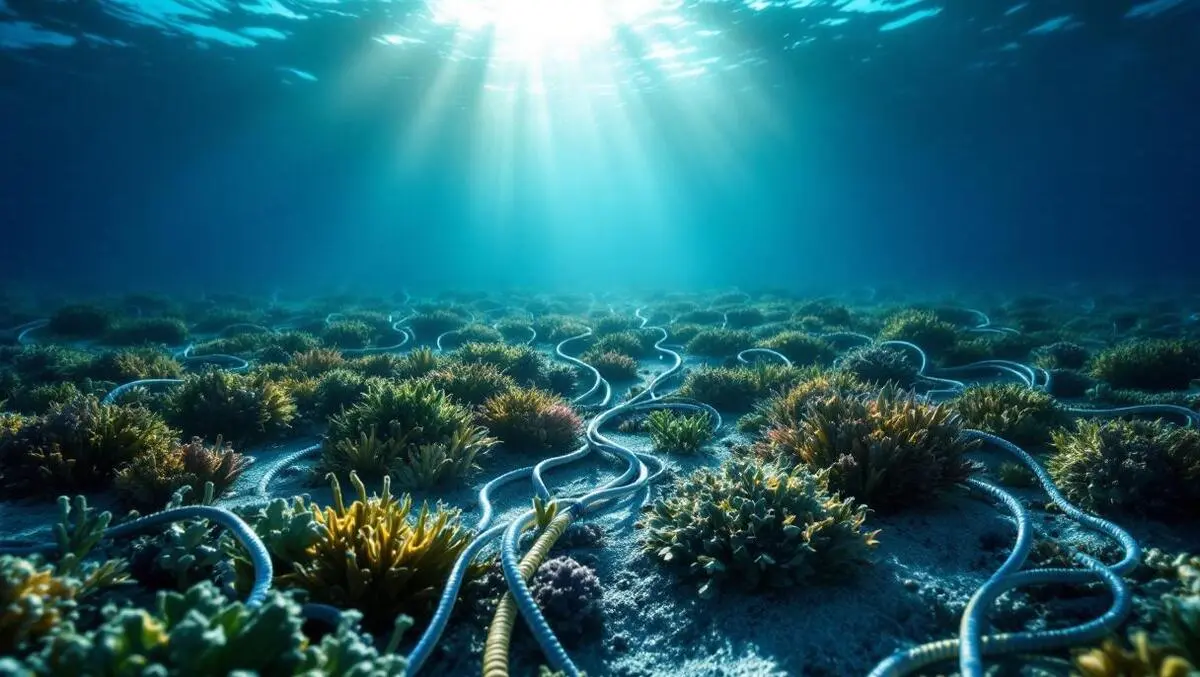
Explainer: Undersea cables quietly powering the AI revolution
Tue, 23rd Dec 2025
In an era of exploding artificial intelligence (AI) workloads, a rarely seen network of undersea fibre-optic cables is quietly becoming more crucial than ever. These submarine cables – which carry about 95 per cent of the world's intercontinental internet traffic – are expanding rapidly to support the data demands of AI and cloud computing across the globe. Once a niche concern for telecom engineers, undersea cables are now strategic assets underpinning the digital economy, enabling everything from video calls to the training of large AI models.
Global backbone
Undersea cables form the hidden backbone of global connectivity. Stretching a combined 1.3 million kilometres under the oceans, these fibre lines link continents and carry an estimated USD $10 trillion worth of financial transactions every day. In fact, more than 95 per cent of international data traffic travels through submarine cables, making them essential for cross-border business, finance and online services. Despite their invisibility in daily life, modern economies and technologies rely on this vast underwater network – and its importance is only growing as data usage soars.
AI boom
The rise of AI is adding a new surge of traffic to these networks. Training and running advanced AI models involves shuttling enormous datasets between data centres, often across different continents. For example, developing a large language model can require processing terabytes of data distributed over global computing clusters – a task that demands high-capacity links with minimal delay. At the same time, real-time AI services such as financial trading algorithms and interactive assistants rely on ultra-low latency connections to deliver instant results for users around the world.
Industry analysts note that AI-related applications currently account for only a single-digit percentage of international bandwidth, but this share is climbing fast. By 2035, AI workloads could consume roughly a third of the capacity on key routes like the busy transatlantic cables, reflecting how quickly data-hungry machine learning tasks are growing.
Tech giants
Recognising the strategic importance of connectivity, the world's largest tech companies have become major builders of undersea cable systems. Firms like Google, Meta, Microsoft and Amazon are no longer just customers of telecom operators – they are funding and laying their own fibre cables beneath the ocean. This shift allows these companies to secure dedicated high-capacity routes optimised for their needs and to add network redundancy on their own terms. By owning infrastructure, they can lower latency for their users and ensure critical services stay online even if other networks fail.
Several recent major projects illustrate this trend. Meta, for instance, has announced a USD $10 billion plan to construct one of the longest cables ever. The 50,000-kilometre cable will connect the US with India, South Africa and Brazil, linking these regions with much higher capacity. Dubbed Project Waterworth, it will use 24 fibre pairs (far more than earlier cable designs) to deliver vast bandwidth for Meta's platforms and future AI initiatives. Meta is also a lead investor in the 45,000-kilometre 2Africa cable – one of the world's largest – linking 33 countries across Africa, Europe and Asia to boost internet capacity in emerging markets.
Google has similarly invested in over 30 subsea cables worldwide. These include private cables like Grace Hopper (connecting the US to the UK and Spain) and Equiano (connecting Europe to southern Africa with 144 Tbps (terabits per second) of capacity). Each new link bolsters Google's cloud data centre network and helps deliver services like search, video streaming and AI-powered applications with lower delay.
Microsoft's flagship Atlantic cable, MAREA – built with Meta – has provided Azure's cloud with a 160 Tbps (terabits per second) connection between North America and Europe since 2018. Microsoft is now planning new, shorter cables between Ireland and the UK, aiming to directly connect its huge Dublin data centre hub to Britain and onward to continental Europe for greater resilience. Amazon, meanwhile, has until now chiefly participated in consortia or leased fibre capacity on existing routes such as the Hawaiki cable in the Pacific. Now the company is moving into owning its own subsea infrastructure. It recently announced a dedicated transatlantic cable (landing in Ireland) slated to go live by 2028, explicitly designed to handle rising cloud and AI traffic on its Amazon Web Services platform.
Underpinning these investments is an effort to future-proof against skyrocketing demand. The latest cable systems can transmit on the order of hundreds of terabits per second – enough bandwidth to stream millions of HD videos simultaneously – which is a necessity as AI and cloud services generate ever-larger data flows. For the tech giants, controlling the oceanic pipelines of data has become as crucial as the data centres and algorithms at the core of their business.
Critical links
The growing dependency on undersea data routes has also put a spotlight on their vulnerability. Unlike satellites, cables concentrate huge volumes of data in physical bundles that can be damaged by natural disasters or human activity. In recent years, there have been several high-profile outages where cables were severed. Whether caused by a ship's dragging anchor or by suspected sabotage, a single cut can knock out internet access to entire islands or regions. These incidents have prompted calls for better protection and redundancy. NATO, for example, launched a dedicated mission in the Baltic Sea in 2025 to deter interference with critical undersea fibre lines after a string of mysterious cable cuts in northern Europe.
Cable operators and governments are responding by building more diverse routes and hardening the infrastructure. New cables like Amazon's planned Fastnet are being routed along less congested corridors and built with extra shielding near shorelines to guard against ship anchors and fishing nets. Companies are burying cables deeper in the seabed where possible and using advanced optical switching systems that can quickly reroute traffic if a line is cut. By spreading data across multiple paths, the aim is to ensure that no single break can knock major services offline. This push for resilience has become as important as raw capacity. It is not just about moving data faster, but also about keeping the data flowing under all circumstances.
Future growth
All signs indicate that the subsea cable boom will continue as the AI era accelerates. Industry forecasts project that annual spending on new cable systems and upkeep will grow from roughly USD $8 billion in 2023 to around USD $10 billion by 2029. Much of this investment is driven by cloud and content companies, often in partnership with telecom carriers, to add both capacity and backup routes. New projects are on the drawing board across the globe – from transatlantic links and pan-Asian cables to regional systems connecting emerging data centre hubs in Africa, the Middle East and Southeast Asia.
Even the advent of low-Earth orbit satellites has not diminished the role of undersea fibre. The sheer volume of data required for AI applications and streaming far exceeds what satellite networks can economically handle, ensuring that subsea cables remain the workhorses of the internet. As more people come online and AI-powered services proliferate, the demand for international bandwidth shows no sign of slowing. The result is an ongoing, largely unseen expansion of oceanic infrastructure beneath the seas. Undersea cables may be out of sight, but they are firmly at the heart of the digital revolution – quietly enabling the connectivity that powers our AI-driven future.